
AI does not need to become a doctor to change medicine
The Legion Health pilot shows AI moving from administrative automation toward participation in real clinical decisions.
The most important thing about the Legion Health story is not that a chatbot can help a patient renew a prescription faster.
It is that, for the first time, we are beginning to test a form of medicine in which a clinical decision becomes a software process: with an intake form, risk thresholds, automatic escalation, auditing, and responsibility divided among a company, physician, pharmacist, regulator, and algorithm.
That does not sound as spectacular as “AI will replace doctors.” Good. Real change rarely begins with full autonomy. It usually begins with something narrow, boring, and repetitive.
A prescription renewal looks exactly like that kind of process.
The important part is not that AI renews prescriptions
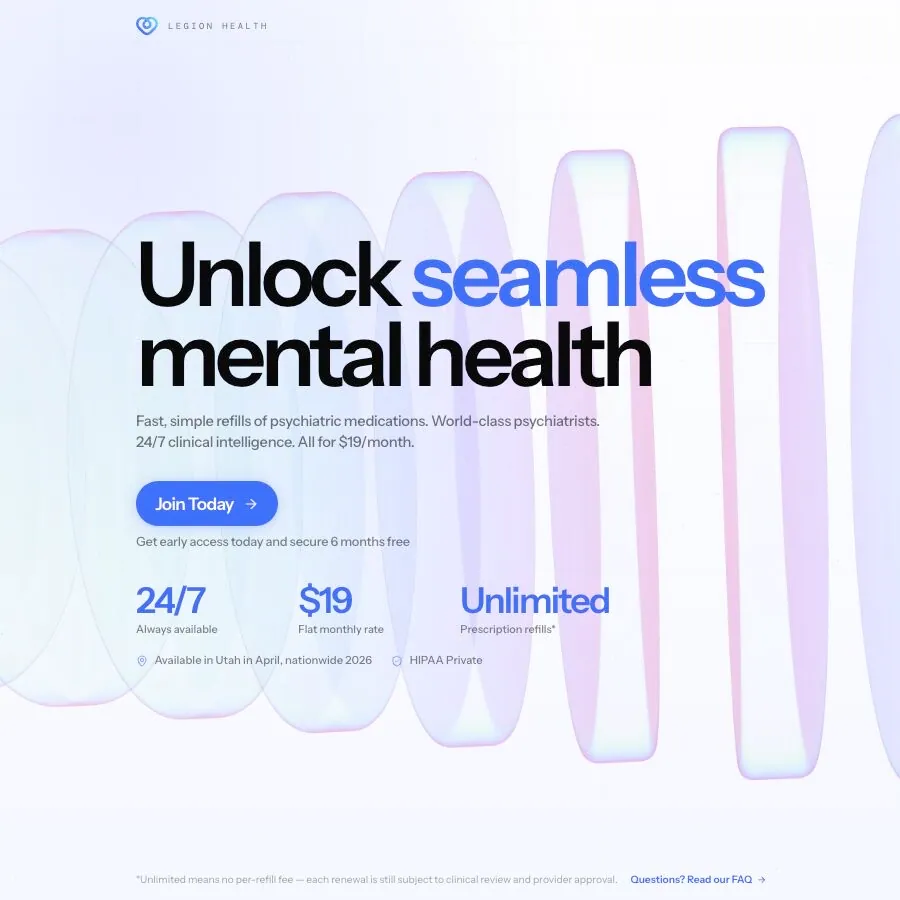
Legion Health, a San Francisco startup backed by Y Combinator, received authorization in Utah to pilot AI-led renewals of selected psychiatric prescriptions under defined and limited conditions. The company describes this as a step toward “autonomous mental healthcare”: a progression from clinician-led workflows, through AI-led workflows with supervision, toward fully autonomous care in well-defined pathways.
That statement matters more than the news itself.
It shows that Legion does not see the pilot as a one-off curiosity. It treats it as evidence that parts of medicine can be broken into repeatable processes, described by rules, protected by exceptions, and gradually transferred from a person to a system.
The question is therefore not whether a chatbot can prescribe Zoloft. It is which parts of healthcare will first be considered routine enough that a human is no longer the default operator.
What exactly happened in Utah
Precision matters here because the story is easy to oversimplify.
The Utah pilot does not mean that any chatbot can diagnose patients and prescribe new psychiatric medication. According to information describing the program, the system is limited to renewals of existing, non-controlled prescriptions. It cannot initiate treatment, change doses, or prescribe higher-risk medications.
Patients must confirm their identity and existing prescription, then answer questions about wellbeing, symptoms, side effects, and risk. Warning signs—such as suicidal thoughts, symptoms of mania, serious adverse effects, or pregnancy—are meant to trigger escalation to a licensed clinician. Patients can also request human review.
The scope is narrow. Reporting on the pilot says Legion’s chatbot can renew a limited list of lower-risk medications that were previously prescribed by a clinician, including fluoxetine, sertraline, bupropion, mirtazapine, and hydroxyzine. Controlled substances, benzodiazepines, medications requiring closer monitoring, antipsychotics, and lithium are excluded.
These limits do not make the story less significant. They show how medical automation is likely to develop: not through one dramatic leap, but through a series of small exceptions, pilots, and supposedly safe processes.
Why psychiatry is the first testing ground
At first glance, psychiatry may seem like a surprising choice. It is a sensitive field built on conversation, context, trust, and the interpretation of signals that cannot always be measured in a blood test.
That is precisely what makes the pilot interesting.
Psychiatry has two sides. On one hand, it is among the most human areas of medicine. On the other, a large part of the system’s daily work consists of repeatable check-ins, prescription renewals, questions about side effects, symptom stability, and basic risks.
For a patient who has been stable for months or years, renewing a prescription can feel like a frustrating administrative barrier. For a physician, it is often necessary but repetitive work. For the healthcare system, it is a bottleneck. For a startup, it is an ideal target for automation.
This is where the tension begins. Something can be administratively routine while still being clinically important.
A prescription renewal is not merely clicking “extend.” It is an opportunity to notice that a medication has stopped working, new symptoms have appeared, the dose is no longer appropriate, or therapy continues only through inertia because nobody has paused to ask whether it is still the best decision.
From automating administration to automating decisions
Legion Health says it built an AI-native psychiatry clinic and automated around 95 percent of administrative work. Y Combinator presents this as a model that allowed the company to grow its care operations without proportionally expanding administrative staff.
That is understandable and, in many areas, desirable. Healthcare is overloaded with administration. Patients wait, doctors drown in forms, and highly qualified people spend time on work that should have been automated long ago.
But automating administration is not the same as automating clinical decisions.
The first asks: how can we process this workflow faster?
The second asks: who has the authority to decide that the workflow should end in a medical action?
This is why the case matters. It captures the transition point. AI is no longer limited to notes, scheduling, conversation summaries, or survey reminders. It begins participating in a decision that produces a real-world action: renewing medication.
The counterargument: it is only a prescription renewal
The fairest counterargument is that we are being dramatic.
If a patient has taken the same medication for two years, remains stable, reports no new symptoms or side effects, and only wants to avoid waiting weeks for a physician, does that person really need a full appointment?
This is not a foolish argument. It is a strong one.
For many patients, healthcare is too slow, too expensive, and too difficult to access. Utah officials point to shortages in mental-health services and argue that automating routine renewals may free clinicians to focus on more complex cases.
If the alternative is losing access to medication, interrupting treatment, or waiting for an appointment only to answer a standard set of questions, a low-cost chatbot may appear entirely rational.
That is why the issue is difficult. Automation is not always bad. The danger is confusing a lack of friction with good care.
Faster does not always mean better. Cheaper does not always mean safer. And “the patient is stable” does not always mean the system should stop looking more broadly.
The problem is not the chatbot. It is responsibility
The biggest question is not whether AI will ask the correct questions. It is who is responsible when it asks insufficient ones.
Utah says established safeguards and legal accountability remain in place, while prescriptions are signed by a licensed physician either directly or through an approved protocol. In practice, however, a new arrangement emerges: a company designs the system, a regulator authorizes an exception, a physician lends clinical authority to the process, a pharmacist may escalate concerns, and a patient answers questions selected by an algorithm.
This is not the traditional doctor–patient relationship. It is a patient–system relationship in which a person appears when software decides that one should.
Critics focus on that threshold. Analyses of the Utah pilot describe it as a regulatory playbook that raises serious questions about who should regulate machines acting like physicians. Giving an AI system the capacity to independently renew prescriptions crosses a boundary previously reserved for people with years of education, training, and licensing.
The later response from the Utah Medical Licensing Board shows that the disagreement is not academic. The board called for the experiment to be suspended, citing patient-safety risks and insufficient consultation with physicians before the program was authorized.
That is the heart of the issue.
AI can help medicine, and it will. The question is whether we accept a model in which responsibility for a clinical decision becomes so distributed that nobody fully owns it in practice.
Conclusion: medicine will not be automated all at once
Legion Health is not merely a prescription startup. It represents a broader shift from AI as an assistant to AI as the operator of a process.
The shift will not begin with the most difficult diagnoses, surgery, or full physician autonomy. It will begin with a renewal, a narrow questionnaire, stable patients, lower-risk medications, a twelve-month pilot, audits, and exceptions.
Then the questions will expand.
If AI can renew 15 medications, why not 50? If it can serve a stable psychiatric patient, why not a stable patient with hypertension? If it can operate in Utah, why not other states? If a physician supervises exceptions, how many exceptions can one physician handle?
This is not the end of doctors. It is the beginning of something subtler: rebuilding medicine around protocols, risk thresholds, and automatic escalation.
In many places, that reconstruction may be beneficial. It may reduce waiting times, lower costs, and free physicians from work nobody will miss.
But if AI is to take on a growing share of medical decisions, the conversation cannot focus only on patient convenience and system efficiency. It must also focus on responsibility.
Medicine does not stop being medicine when the process begins to resemble a well-designed workflow.
Sources
Frequently asked questions
Can AI in Utah independently start psychiatric treatment?
No. The pilot covers a narrow set of renewals for existing prescriptions involving selected lower-risk medications. The system cannot initiate new treatment or freely change doses.
Why is the Legion Health pilot important?
It marks a move from AI supporting administration to AI participating in a workflow that ends in clinical action. It also reveals how difficult it is to allocate responsibility among the company, physician, regulator, and system.