
BLIK’s greatest success? We stopped noticing we use it
BLIK’s greatest achievement is not transaction volume, but the way it became an invisible part of everyday payment habits.
The most successful technologies share a paradoxical quality: the more important they become in our lives, the less we notice them.
At first, every innovation demands effort. We need to understand it, learn a new behavior, trust the solution, and consciously decide to do something differently. Then the technology begins to disappear. We do not think about internet protocols while streaming a film or about contactless standards when tapping a phone against a terminal. We simply complete the task.
BLIK has followed exactly that path in Poland. A solution that needed explaining a decade ago has become part of everyday life. Increasingly, it is the default way to pay, withdraw cash, or settle up with another person.
The BLIK story is therefore more interesting than a chart showing one transaction record after another. It is the story of a technology that not only won market share, but changed behavior.
From innovation to reflex
I have been a BLIK enthusiast since its earliest days. From a user’s perspective, it now seems obvious — until we remember what online payments and sending money to someone looked like ten years ago.
Buying online often meant taking out a card, typing a long number, entering its expiry date and security code. Sending money to a friend required a bank-account number. Forgetting your wallet could end a shopping trip. Today we enter a six-digit code, approve the operation in a banking app, or choose the recipient from our contacts.
Recently I helped an older woman who realized at the checkout that she had left her wallet at home. A few years ago she would have had to abandon the purchase or go back. This time we paid with BLIK. What mattered most was that the solution required no long technical explanation. It was treated not as a novelty, but as a practical answer to a problem.
That is the moment when innovation becomes infrastructure.
BLIK started somewhere very different
Looking at BLIK today, it is easy to assume it was designed mainly for online payments and transfers to a phone number. The data tells a different story.
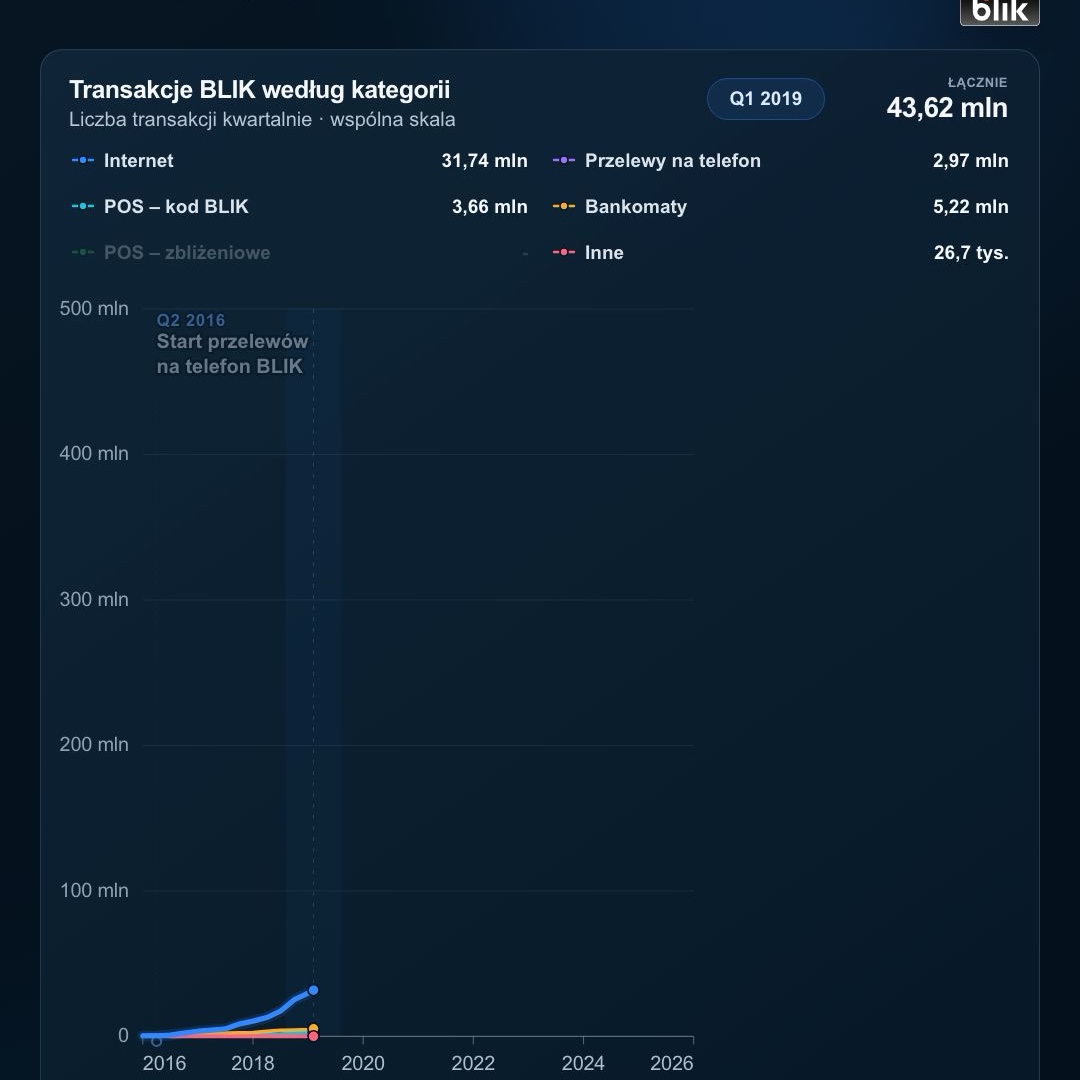
At the beginning of 2016, ATM withdrawals accounted for more than half of all BLIK operations. The system itself had launched in February 2015 through six banks, and users completed fewer than two million transactions by the end of that first year.
Technologies do not always win because of the use case they started with. Sometimes the first feature is merely an entry point: a way to build reach, trust, and a place in everyday life. Only later do the applications emerge that define the product for the next decade.
The internet became BLIK’s natural environment
Online payments are now BLIK’s largest transaction category. In the first quarter of 2026, users made about 377.8 million of them — more than four million per day.
The BLIK code was first a novelty, then a convenient alternative to cards and conventional bank transfers. For many people, it eventually became the first choice at online checkout.
The system used a particular strength of the Polish market: mature mobile banking and direct presence inside banks’ own apps. A user did not need another account, password, or company holding their data. The solution appeared in an environment they already used and trusted.
A transfer stopped feeling like a banking operation
Around 184.6 million phone-number transfers were made in the first quarter of 2026. They already represented nearly one quarter of all BLIK operations.
A traditional transfer was an operation between accounts. It required an account number, recipient details, and a payment reference. A BLIK transfer feels like an operation between people. We do not send money to an account; we send it to Anna, Paul, or Michael. Banking infrastructure disappears beneath the contact list.
This is a small technological difference but a major psychological one. Sending money starts to resemble sending a message and fits naturally into everyday situations: splitting a restaurant bill, buying a group gift, paying for tickets, shopping for a friend, or sharing travel expenses.
Offline caught up with online
For its first few years, BLIK was associated mostly with codes entered at online checkouts or ATMs. At a physical terminal, however, it competed with an extremely convenient contactless card.
Contactless BLIK payments, launched in 2021, changed the situation. In the first quarter of 2026, code and contactless payments at terminals together accounted for more than 170 million transactions — close to 23 percent of total volume.
This part of the story is a reminder that convenience is contextual. One interaction does not have to be optimal in every channel. A coherent product does not mean an identical experience in every situation.
From ten thousand to millions of transactions a day
At the beginning of 2016, the system processed roughly ten thousand transactions per day. In the first quarter of 2026, the average was about 8.4 million per day — more than an 800-fold increase in a decade.
Meanwhile, ATM withdrawals, originally the majority of operations, now account for about 2.6 percent of volume. The system did not grow only by scaling its first feature. It expanded into online shopping, person-to-person payments, point-of-sale transactions, cash withdrawals, and automatic or deferred payments.
In 2021, BLIK reported 763 million transactions across the entire year. A few years later, a similar volume is completed in a single quarter. At some point a product stops being merely a service. It becomes a standard.
Did BLIK win because Poland was ready?
Poland has long been a market that adopts electronic banking, contactless payments, and mobile apps quickly. BLIK benefited from strong Polish banks, popular banking applications, and cooperation between institutions that compete in other areas.
A favorable market does not guarantee success. BLIK combined simplicity, availability across many banks, a growing acceptance network, trust, and a steady stream of new use cases.
Its success did not depend on one technological breakthrough. It came from consistently removing reasons for users to choose another method.
Habit is the real advantage
A card, digital wallet, instant transfer, and banking app can all deliver a similar result. The difference is behavioral: which method do we choose without thinking, which one do we trust, and which requires the fewest decisions?
That is why BLIK’s most valuable asset may not be the technology itself. It is the habit. Every successful transaction reinforces the belief that the system is fast, safe, and widely available. Eventually, the user stops comparing options and chooses the one that has become the default.
A feature can be copied, an interface recreated, and prices lowered. A behavior reinforced by millions of repeated experiences is much harder to reproduce.
Where can BLIK go next?
The next stage may be less visible than the move into online payments or phone-number transfers. It may involve transactions that users do not initiate every time with a code or tap.
Recurring payments, subscriptions, cross-border commerce, deferred payments, transport, automated settlements, and purchases made by AI agents shift the question from “how do I pay?” to “when and under what rules can this payment happen without my active involvement?”
Automation requires another kind of trust: trust in limits, rules, subscriptions, recommendations, and decisions made in the background. Perhaps BLIK’s next success will not be another place where we enter a six-digit code, but a system in which we need to enter one less often.
Technology wins when it stops being the topic
Hundreds of millions of quarterly transactions and successive records show the scale, but not why the story matters.
BLIK’s greatest success is that mobile payment stopped being a demonstration for enthusiasts or an extra option hidden inside an app. It became one of the basic ways people pay and settle up in Poland.
The most successful technologies do not demand constant admiration or make us think about the infrastructure working behind the scenes. They simply let us complete the task.
And that may be what BLIK has done best. It did not only change how we pay. It made us stop thinking about the act of payment itself.
Frequently asked questions
How did BLIK change payments in Poland?
It hid much of the payment infrastructure behind a simple code, a banking app, and the phone contact list. It made online payments, person-to-person transfers, and in-store payments easier.
Why did BLIK become so popular?
It combined simplicity with direct availability inside trusted banking apps, broad acceptance, and a steady expansion into new use cases.
What is BLIK’s greatest competitive advantage?
User habit. A feature or interface can be copied, but behavior reinforced by millions of successful transactions is much harder to reproduce.