
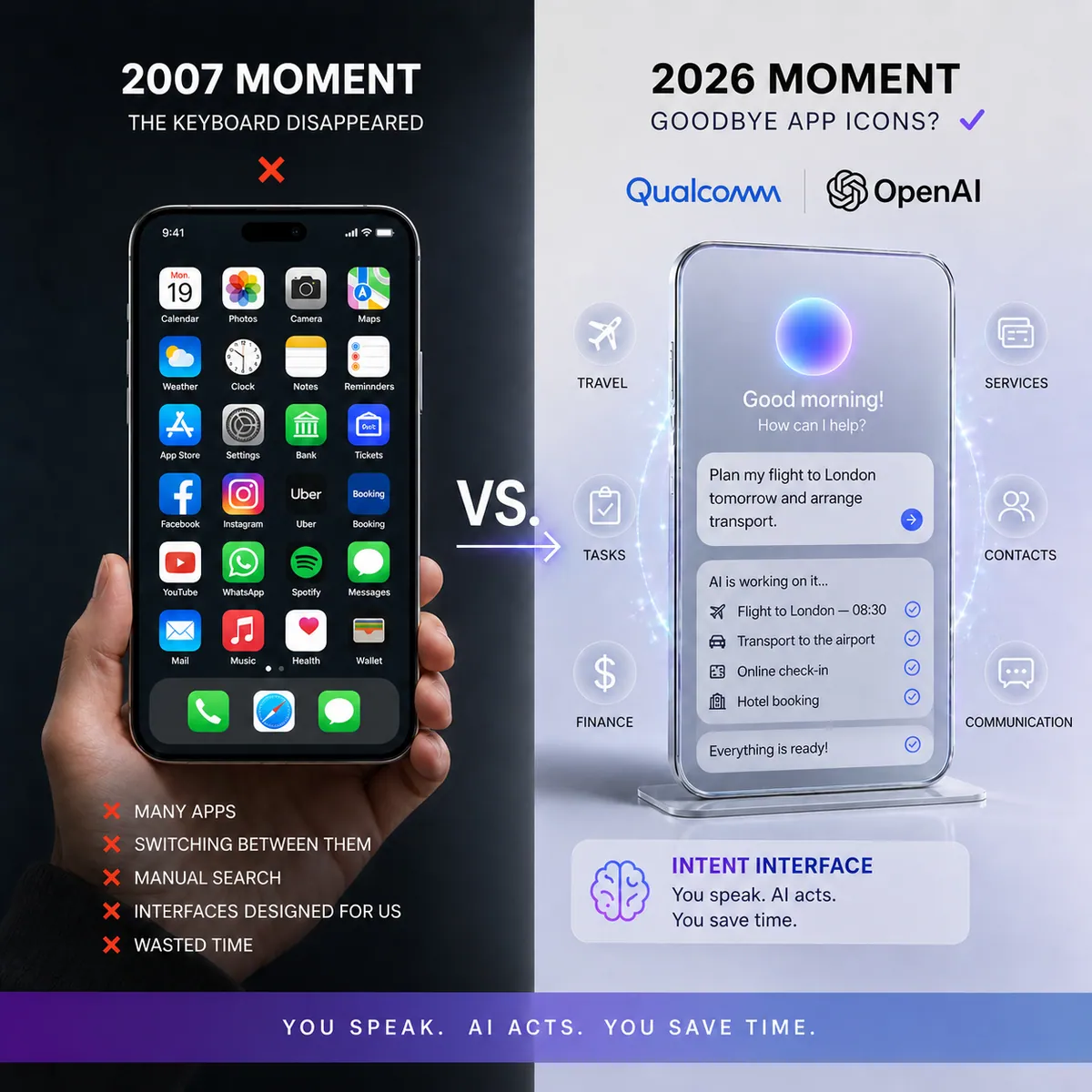
The end of app icons? The smartphone is entering the age of the intent interface
Instead of opening one app after another, we may state an intention and let the phone select the services, data, and actions required to fulfil it.
In 2007, Steve Jobs did something that seems obvious in retrospect but was radical at the time: he removed the physical keyboard from the phone.
To many people, the idea sounded absurd. How could anyone type on glass? How would a device work without buttons? How could users trust a screen that offered no physical resistance?
The answer was simple, although it only became obvious later: physical buttons were too rigid for the world of software.
The phone stopped being a device for making calls. It became a screen that could instantly turn into a keyboard, camera, map, game console, wallet, notebook, store, or remote control for an entire digital life.
We may now be approaching a similar moment.
This time, however, the keyboard is not the element waiting to be removed.
The apps are.
Not in a technical sense. Apps will not disappear overnight. They will still be needed as transaction systems, data sources, integration layers, security tools, and branded environments.
They may, however, stop being the primary gateway to the digital world.
From the keyboard to app icons
For more than a decade, the smartphone has followed a remarkably stable operating model.
Want to order food? Open a food delivery app.
Want to make a bank transfer? Open the bank’s app.
Want to buy a ticket? Open the transport provider’s app.
Want to fly to London? Start with the airline app, then move to a hotel app, map, taxi service, calendar, email, and perhaps the weather app too.
This feels natural because we have become accustomed to a digital world organised around icons.
The icon is the gateway. The app is the place. The app interface defines the rules.
The problem is that this model has started to resemble the physical keyboard before 2007. It is useful but rigid. It works well for individual tasks and less well for intentions that cut across several services at once.
Our lives rarely conform to the boundaries of apps.
We do not think: “I want to perform an operation in my banking app, then another in a transport app, followed by one in a hotel app.”
We think: “I need to be in London tomorrow, and I do not want to spend an hour organising it.”
Why apps have become the new keyboard
Mobile apps were a major breakthrough because they reorganised the internet for the touchscreen.
Instead of websites poorly adapted to phones, we received native experiences that were faster, simpler, and more predictable. The App Store and Google Play transformed software distribution, while home-screen icons became the new map of the internet.
Every map eventually starts limiting the way we think.
Apps created a world of silos. Every brand designs its own interface, journey, notifications, loyalty programme, and language. Users jump between them and learn a growing collection of small systems.
From a company’s perspective, this is convenient. The app provides control over the experience, data, branding, sales, and customer relationship.
From the user’s perspective, it is increasingly administrative work.
I need to know where to tap. I need to remember which app contains the information. I need to understand different interfaces. I need to connect dates, prices, offers, tickets, terms, and restrictions myself.
AI promises something different: not another screen, but a shorter distance between intention and outcome.
The intent interface: a phone that understands the task
This new paradigm can be described as an intent interface.
It does not begin by asking, “which app do you want to open?”
It begins with, “what do you want to achieve?”
The user says: “Plan my flight to London tomorrow and arrange transport.”
A capable AI agent should understand that this is not one task. It is an entire chain of decisions.
It needs to check the calendar, know the preferred airport, compare flights, respect the budget, suggest a departure time from home, arrange transport, and add events to the calendar. It may also prepare a boarding pass, reminder, and short itinerary summary.
Under the old model, users assembled this process themselves across several apps.
Under the new model, an agent can become the coordinating layer.
Reports about a possible OpenAI phone built around agents are interesting not merely because OpenAI might make a phone. The more important premise is that a device could be designed around AI agents rather than a traditional grid of apps.
Even if a particular product turns out differently, is delayed, or never reaches the market, the direction matters.
The phone of the future may be less a catalogue of apps and more an operating system for intentions.
Apps will not disappear. Their place in the value chain will change
The biggest mistake would be to claim that apps will simply die.
They will not.
Websites did not disappear when mobile apps arrived. Shops did not disappear when marketplaces arrived. Radio did not disappear when podcasts arrived.
Their role will change.
Apps may become backends for AI agents—less a destination users consciously enter and more a collection of functions, data, and permissions used by an intelligent intermediary.
For companies, this is an enormous shift.
Until now, the competition focused on the home-screen icon, a place in the user’s memory, and repeat visits to the app. In an agent-driven world, the competition may move to integration quality, APIs, data, availability conditions, and trust.
If the user no longer opens a hotel app but asks an agent to “find a sensible hotel close to my meeting,” the hotel brand loses part of its direct contact.
If the user does not browse a banking app but asks, “can I safely buy this ticket and how will it affect my budget?”, the bank stops being a screen and becomes a source of context.
If the user does not enter a shopping app but says, “reorder the product I usually buy, only cheaper,” the marketplace becomes one of several possible execution layers.
This is not a minor UX change. It shifts control over the relationship with the user.
The biggest problem: brand loyalty
In the app world, a brand can build a relationship through its interface: colours, notifications, offers, loyalty programmes, personalisation, microinteractions, screen order, and tone of voice.
In an agent world, an intermediary may take over part of that relationship.
If an agent chooses a service for the user, the brand faces an entirely new question: how can it be selected when the user no longer “enters” the brand?
This could be particularly painful for companies that spent years investing in apps as their primary relationship channel. Owning an app appeared to offer independence from platforms. Yet a new platform may now emerge above the apps: the user’s agent.
Loyalty will no longer come only from logo recognition. It will depend on whether a service is trustworthy, well integrated, predictable, secure, and genuinely beneficial at the moment of decision.
This may be a healthy change. It will also be uncomfortable for many brands.
The winner will not be the company that shouts loudest through notifications. It will be the service the agent considers the best response to the user’s intention.
Why on-device AI is crucial
There is another element to this shift: privacy.
If an agent is to help meaningfully in everyday life, it must understand a great deal of context: calendar, location, purchase history, preferences, contacts, documents, habits, health, finances, travel style, and working patterns.
This data is too sensitive to send thoughtlessly to the cloud with every command.
That is why on-device AI—artificial intelligence running locally on the device—is not merely a technical curiosity. It may be a condition for trust.
Qualcomm has been communicating precisely this direction. The company demonstrates AI models running on Snapdragon processors and points to privacy and low latency as key benefits of local processing.
This matters because an AI agent without privacy can quickly become a nightmare.
A phone that understands your intentions is a powerful tool.
A phone that understands your intentions and continuously sends them to external systems is a social, regulatory, and business problem.
The future of the smartphone will therefore not be decided by language models alone. It will also be decided by the architecture of trust: what happens locally, what reaches the cloud, who can access the data, and who makes decisions on the user’s behalf.
The counterargument: people still want control
Of course, all of this can sound like another wave of technology hype. There is good reason for scepticism.
History contains many attempts to “kill the app.” Voice assistants were supposed to change everything. Chatbots were meant to replace interfaces. Super-apps were going to unite the entire internet in one place. Most of those promises produced far more modest results.
There is a second problem: control.
We do not always want something to “just happen.” Sometimes we want to see the options, compare them, click, decide, think, change our mind, and understand why the system made a recommendation.
An intent interface cannot become a black box.
If an agent is going to buy a ticket, book a hotel, or make a transfer, it needs to explain the logic behind the decision. It must allow approval, respect boundaries, and understand when it can act independently and when it should ask.
Apps will not disappear completely. In many situations, we will still need a visual, precise, controlled interface.
The question is therefore not whether apps will disappear.
The question is how many everyday situations will no longer begin with an app.
What might actually disappear?
Software will not disappear.
Services will not disappear.
Brands will not disappear.
Even apps themselves will not disappear.
What may disappear is the assumption that users should operate the entire digital maze themselves.
For years, technology has given us more possibilities and more micro-obligations: more accounts, more apps, more consent screens, more settings, more notifications, and more interfaces to learn.
AI may be the first technology to genuinely reduce that operating layer.
Or it may cover it with a new and even less transparent layer of intermediaries.
That is the real stake.
It is not about whether the phone of the future has fewer icons. It is about who interprets our intentions, who executes them, and under whose rules.
In 2007, the smartphone stopped being a phone with a keyboard.
In the coming years, it may stop being a screen filled with apps.
It may become something much more important: an interface to everyday life.
Then the most important question will no longer be, “what do you have installed on your phone?”
It will be: “Who do you allow to act on your behalf?”
Frequently asked questions
Will AI completely replace mobile apps?
Probably not. Apps will continue to function as systems, data sources, and secure interfaces, but an AI agent may increasingly become the user’s first point of contact.
What is an intent interface?
It is a way of operating a device that starts with the user’s goal rather than the choice of an app. An agent selects the necessary services and proposes the next actions.