
A branded mobile network? MVNO only makes sense when it becomes part of loyalty
Mobile service can be more than connectivity. When linked with an app, points, and everyday habits, it becomes another layer of the relationship between a brand and its customers.
A branded mobile network sounds like an idea from the previous decade—until we stop looking at it as a telecom product and start seeing it as another part of a loyalty programme.
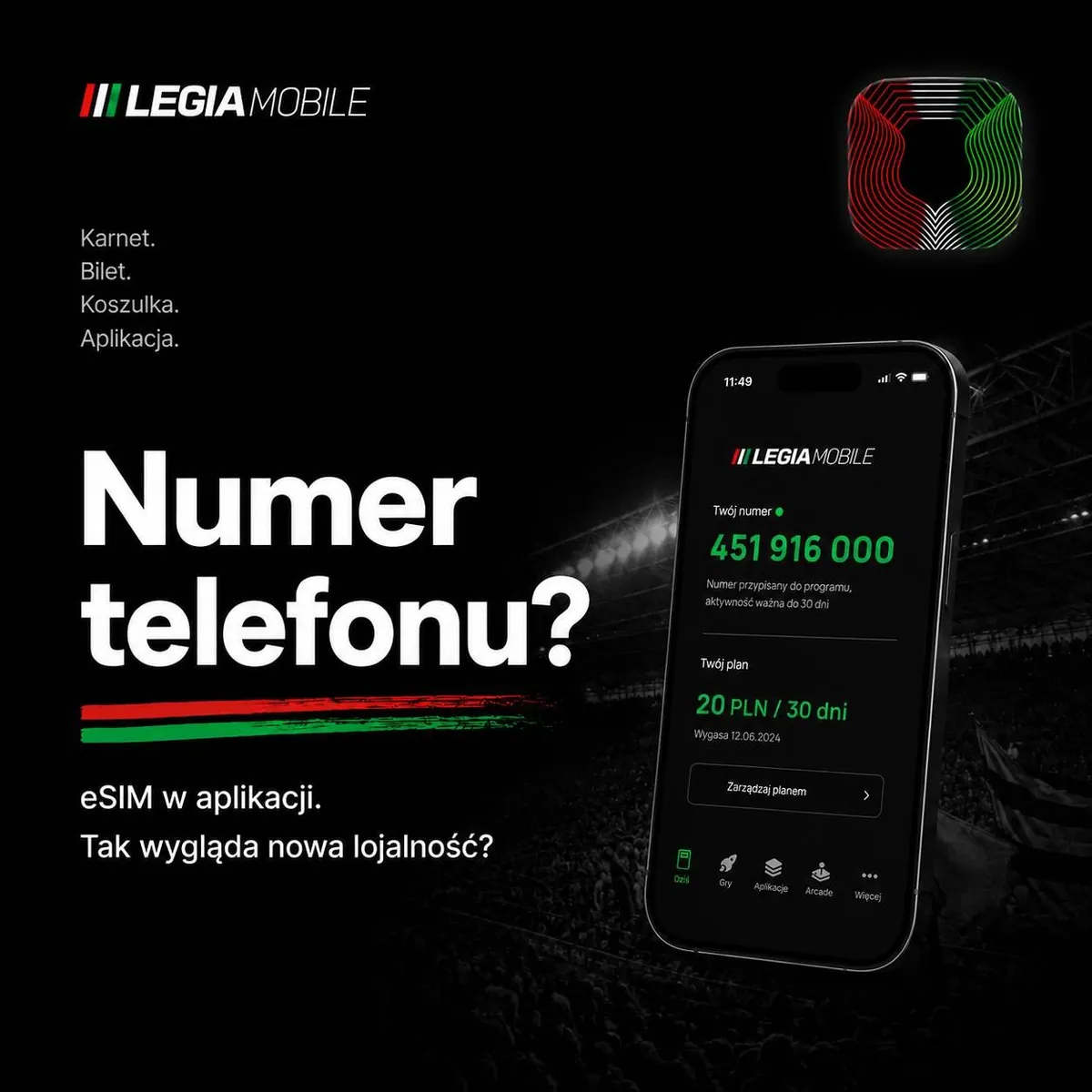
I recently heard an advertisement for Legia Mobile and caught myself wondering: why would one of Poland’s biggest football clubs need its own mobile network?
Technically, there is nothing revolutionary about it. MVNOs, or mobile virtual network operators, have existed for years. A brand does not have to build masts, radio infrastructure, or a complete telecom business from scratch. It can use a larger operator’s infrastructure and wrap the service in its own brand, app, offer, and communication.
That is precisely why the subject is interesting. Once the technical layer is put aside, a strategic question remains: can mobile service become part of a loyalty programme?
I believe it can—but only on one condition. It cannot be merely another logo on a SIM card.
Legia Mobile: an operator as part of the supporter relationship
Legia Mobile launched in June 2026 as the MVNO offer of Legia Warszawa. According to the club’s communication, it has no long-term contracts, offers three prepaid plans, and includes a distinctive “goal equals gigabyte” mechanic: every goal scored by Legia gives active users an additional 1 GB of data.
That is the most interesting part of the entire idea.
Not the mobile service itself. Not another data package. Not a SIM card in club colours. The real idea is to connect a telecom service with the emotion of supporting a team.
A supporter is not only buying mobile data. They are buying another everyday point of contact with the club: a season ticket, match ticket, shirt, app, loyalty programme, club content, store, stadium—and now a phone number too.
This is not proof of success. It is an intriguing signal of how thinking about loyalty may be changing.
For years, loyalty programmes were built around a simple mechanism: buy, collect points, exchange points. Apps, personalised coupons, subscriptions, statuses, tiers, presale access, and special offers followed. Now another element may join that system: a service customers pay for monthly and use every day.
Mobile connectivity is one of the most everyday services there is.
MVNO is not new. The context might be
Virtual operators are nothing new. Poland has already seen many attempts to build mobile offers around familiar brands: tuBiedronka, mBank Mobile, Red Bull Mobile, GaduAIR, WPmobi, MobilKing, and others. Some disappeared, some were absorbed, and some never achieved meaningful scale. The Polish market was describing MVNOs as marginal ventures many years ago, with projects such as mBank Mobile and tuBiedronka treated as side activities by their brand owners.
There is an important lesson here.
A large brand is not enough. Recognition is not enough. A customer base is not enough. Even affection for the brand is not enough.
Customers do not wake up wanting “mobile service from brand X.” They already have an operator and a number they will not move without a good reason. They have a data package, a family plan, a promotion, a habit, or simply no desire to change.
An MVNO based only on a familiar logo is therefore a weak product. It is a telecom branding gadget.
An MVNO embedded in a larger ecosystem can be something different. It can become a tool for improving retention, contact frequency, customer value, and attachment to an app.
Why earlier Polish attempts never became mainstream
Earlier projects often tried to sell mobile service primarily through the power of the brand. Yet a familiar logo does not remove the customer’s cost of switching. People still need to compare the offer, trust the customer service, transfer a number, and find a reason to abandon something that already works.
Those projects also lacked the mature ecosystems of apps, payments, and data that now allow brands to combine multiple services in one place. Mobile remained a separate product instead of becoming a natural extension of an existing relationship.
Tesco, Lidl, Coop, and Sky: mobile as an ecosystem layer
This logic is easiest to see outside Poland.
Tesco Mobile serves more than 5.5 million customers in the United Kingdom and is closely connected to the Tesco brand and Clubcard logic. Tesco does not sell mobile service in a vacuum. It sells it to people who already visit its stores, use its app, collect points, respond to promotions, and are accustomed to Tesco being part of their everyday shopping.
A similar logic can be seen in Lidl Plus and eSIM plans. In 2026, Lidl announced a partnership with 1GLOBAL to develop mobile services in multiple countries and integrate connectivity plans directly into the Lidl Plus app. Users are expected to buy eSIM plans within an environment they already know.
That is a significant change.
Mobile service no longer begins in an operator’s store or with a traditional number-transfer sales process. It begins inside an app the customer already has, understands, and uses.
CoopVoce in Italy is another useful example. The operator linked to the Coop retail network is one of the country’s largest MVNOs. Sky Mobile demonstrates another version of the same logic: mobile service forms part of a broader package of television, broadband, devices, apps, and entertainment.
In every one of these examples, mobile is not the brand’s main product. It is another layer of the relationship.
The essential difference: logo versus usefulness
This is the heart of the matter.
When a brand simply places its logo on a mobile offer, customers see another operator. Another operator usually means more work: comparing prices, checking coverage, transferring a number, understanding the terms, and trusting customer service.
Perception changes when mobile service solves a real problem or strengthens an existing relationship.
Shopping can earn points. Points can reduce the mobile bill. A plan can unlock additional app benefits. The app can become the place where customers manage purchases, promotions, payments, subscriptions, tickets, accounts, and mobile service.
At that point, the MVNO stops being “the brand’s mobile network.” It becomes part of the loyalty system.
For the brand, this creates several potential benefits.
First, more frequent customer contact. Shopping in a store or on a platform may happen every few days or every few weeks. A phone works every day.
Second, stronger retention. The more services customers have in one ecosystem, the harder they are to lose—not because they are trapped, but because convenience starts working in the brand’s favour.
Third, new information about behaviour and needs—provided, of course, that privacy rules, consent, and a sensible data policy are respected.
Fourth, the opportunity to build a subscription relationship. Branded mobile means a monthly payment relationship rather than a one-off transaction.
Which Polish brands could make the strongest case for an MVNO?
Not every brand should pursue this direction. Most should not.
An MVNO only makes sense where three conditions exist: a large customer base, frequent contact, and a genuine reason for customers to use mobile service from that particular brand.
Allegro? Potentially. It has an enormous user base, Allegro Smart!, payments, a marketplace, advertising, merchants, and an everyday shopping relationship. An MVNO could become part of the benefit package, but only if it genuinely strengthened Smart! or created advantages in shopping, delivery, or payments.
InPost? A fascinating candidate. Its app is one of Poland’s most useful consumer apps. A brand that already maintains regular contact through parcels, notifications, returns, and payments could theoretically add digital services. The question is whether mobile would feel like a natural extension or merely an add-on.
Orlen? It has scale, retail locations, an app, a loyalty programme, payments, fleets, and both consumer and business customers. An MVNO could make sense when connected with mobility, vehicle fleets, charging, fuel, and driver services.
A bank? Banks have trust, apps, payments, and frequent customer contact. Mobile from a bank may nevertheless be emotionally harder to accept. Customers may not want their bank to become even more deeply embedded in daily life. The boundary between convenience and excessive closeness is very thin.
An airline? An interesting but more specialised case. An eSIM for travellers, roaming, miles, lounge access, status, and overseas data packages sounds more natural than a traditional domestic operator. It would be a travel product rather than a full MVNO.
Sports clubs? Legia is testing the most interesting emotional variant. Its scale is smaller than retail, but the engagement of its most loyal customers may be much stronger.
The counterargument: customers do not need another operator
The strongest counterargument is simple: people do not need another mobile network.
That is true.
The telecom market is competitive, Polish prices are relatively attractive, and basic services are increasingly difficult to distinguish. For many customers, an operator is infrastructure rather than an emotional brand. It should work, offer coverage at a fair price, and avoid becoming irritating.
Most branded MVNOs will therefore struggle.
It is not enough to say, “we now have our own mobile service.” The brand must answer a different question: “why would a customer want mobile service specifically from us?”
If the answer is “because they recognise our logo,” it is not enough.
If the answer is “because the service lowers their costs, strengthens the loyalty programme, provides tangible app benefits, simplifies travel, connects with a subscription, or offers something unavailable from a conventional operator,” then the conversation starts to make sense.
Conclusion: an MVNO does not sell minutes. It sells a place in the customer’s daily life
The most interesting part of brands returning to mobile is not that more companies want their own network.
It is that mobile may become another field in the competition for loyalty.
This is no longer only about minutes, gigabytes, and text messages. It is about a place in the app, frequency of contact, points, statuses, rewards, subscriptions, and services that together form the customer’s everyday ecosystem.
Legia Mobile is interesting not because a football club became an operator. It is interesting because it reveals a change in thinking: the most engaged customer does not have to own only a scarf, season ticket, and app. They may also use a club-linked service every day.
An MVNO as a standalone operator is a difficult business.
An MVNO as a loyalty layer may be something far more interesting.
That is why the question is not which Polish brand could launch its own mobile network.
The better question is this: which brand has a relationship with its customers that is strong, frequent, and useful enough for mobile service to become its natural extension?
Frequently asked questions
What is an MVNO?
An MVNO is a mobile virtual network operator that sells services under its own brand while using the radio infrastructure of a larger network operator.
When does a branded mobile network make sense?
When a brand has a large customer base, frequent contact with those customers, and can connect mobile service with tangible benefits in its loyalty programme or app.